Showing posts with label books. Show all posts

Monday, November 24, 2014

What I'm consuming these days

I started an MSc in October. The hours are long, but at least the work is hard. I'm not having as much time to make or read or watch as I'd like, but there've been a few books/films/shows that have stuck out, and are a good way of figuring out what I want to make.

1. I started Moby Dick in August and I'm only half-way through. I'm a speedy enough reader, but as I said, I have a shortage of time and nothing goddamn happens. There's stuff to like in it - the description of Queequeg comes from a fond if intensely racist place - but Ishmael keeps stopping to describe how much he likes the sea for an entire chapter, or list everything he knows about whales, and I don't care. Ahab is also contemptible. I think you're meant to view him as pathetic and twisted, consumed by revenge, and yet admirable in his pursuit of his dream, but I can't get past "pathetic". Also, hell of a victim complex, wanting to kill something for daring to hurt him in self-defense. Also: "Gifted with the high perception, I lack the low enjoying power." I went out with that person, and it was awful. (They loved Moby Dick. I got to that line and it became apparent why.) It reminds me a little of Philip Roth for its time - by a dude with a boring notion of integrity and masculinity, for dudes with a boring notion of integrity and masculinity. I'll finish it, but I don't expect to start enjoying it, which is a pity.

2. Lights Out. I watched this yesterday, and I'm enamoured. I love short horror. It doesn't bother with world-building or explanations, which can undo a good monster. It captures a very childish fear, and has the protagonist trying to behave maturely while clearly fighting those childish self-preservation instincts. This pushes a lot of the right buttons for me. When I switched off the light before I went to bed, I felt a flash of anticipatory terror, expecting cruel claws around my spine and Achilles' tendon. I think that's a good sign in two and a half minutes.


The ending undoes it a little, but that's the nature of short horror special effects.

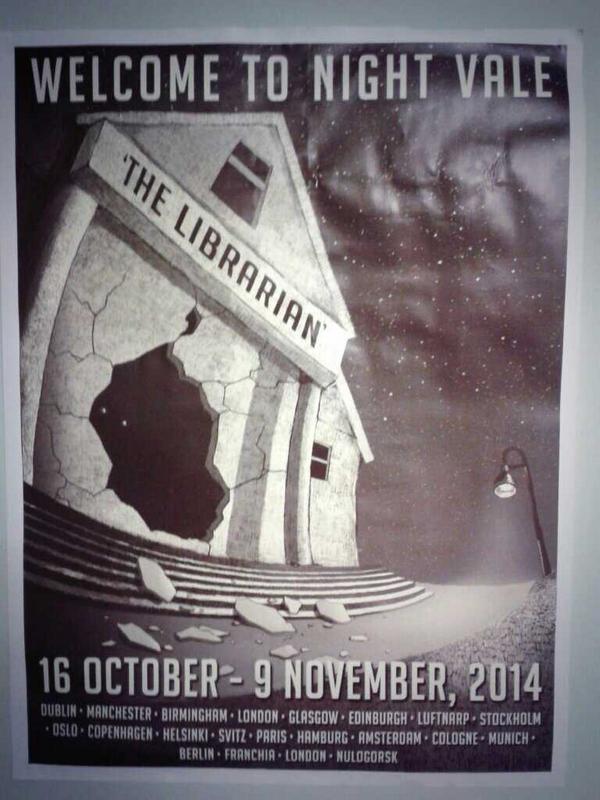
3. I saw Welcome To Night Vale's live show The Librarian in The Olympia in October. The Sugar Club sold out in no time, apparently, but I think a theatre was the right venue for it. I have the same problem with Night Vale I have with anything once I catch up on marathoning it. I get immersed in a world, and once I get out I can't get into it the same way. When I started listening it made me laugh until my face hurt, and now I think it's still clever, but I'm a little inured. I also have mixed feelings on the fandom - I think it's quite wonderful how people have created canon imagery to go along with it, but I also find the fandom pretty annoying, and I'm not sure how I slot in with that, as a fan who's not in the fandom.

That said - oh wow does it work live. As a podcast, it's all about the writing. Weird things happen, and some of those weird things are very intelligent, but I love the wordplay, the imagery, the sense that they take real joy in it. There are some absolute gorgeous turns of phrases in there. It's carried by Cecil Baldwin's voice - Jesus, that voice - and it's rich and dark and knowing and innocent and edged with savagery, and just right. I wasn't sure how that would translate to the stage. The show was mostly Cecil in the middle of the stage with a script in his hand, and it was absolutely mesmerising. The podcast can't convey his presence, his magnetism. I'm interested in the way stories are told, and he told a story with his whole body. He could make your heart race and create the most wonderful terrible silence. I lack charisma or story-telling flair, so both are something I find compelling. I went in thinking he was a man with a wonderful voice, I left thinking him so attractive it makes me angry. I'm a sucker for a story-teller.

I've given a few public talks in the last year - I spoke at Electric Picnic, so I think I get to say now that I've performed at Electric Picnic - almost all pop-science. There's been a lot of figuring out what works on me and what doesn't. I can't do jokes with a build-up - I get a better laugh with off the cuff-remarks. I can play to my advantage the fact that I'm quite an awkward presence. People don't expect me to be funny, they expect me to plod through something I've clearly learned by heart, so a straight-faced one-liner, in the same tone (slightly over-eager, slightly apologetic for taking up the audience's time) works well against that. I shift around a lot, which I can exaggerate and have read as energy or enthusiasm, and my body language is quite deferent, which, again, complements comedy to which I can play oblivious. I can't stand on a stage and spell-bind people - I don't have the voice or presence - but I can wrong-foot a room full of people and make them laugh when I want them to, and that's not something I expected to be able to do.

4. I'm late to the game, but I'm digging Lana del Rey. Her voice drips with sorrow, and I really like love songs that are broken without romanticisation.

I have so many books to read and there are so many good films in the cinema! One day, I will create for myself a world where I have free time, and it will be awful.

Sunday, August 4, 2013

Title Chapters for Harry Potter agus an Órcloch

For my own entertainment.

Harry Potter agus an Órchloch : Harry Potter and the the Stone of Gold*

Caibidil 1: An Gasúr a Tháinig Slán : The Young Boy Who Arrived Safe/Got Through Safe
Caibidil 2: An Ghloine a d'Imigh As : The Glass That Disappeared (From Itself)
Caibidil 3: Na Litreacha : The Letters
Caibidil 4: Coimeádaí na hEochracha : Keeper of the Keys
Caibidil 5: Go Diagon Alley : To Diagon Alley
Caibidil 6: An Turas ó Ardán a Naoi agus Trí Ceathrú : The Trip From Platform Nine and Three Quarters
Caibidil 7: An Hata Sórtala : The Hat of Sorting
Caibidil 8: Máistir na bPosóidí : Master of Potions
Caibidil 9: Comhrac ar Uair an Mheán Oíche : Action** at the Hour of Midnight
Caibidil 10: Oíche Shamhna : Hallowe'en
Caibidil 11: Quidditch : Quidditch
Caibidil 12: Scathán na Mianta : The Mirror of Wishes***
Caibidil 13: Nicolas Flamel : Nicolas Flamel
Caibidil 14: Dragan Dronnach na hIorua :  The Hump-Backed Dragon from Norway
Caibidil 15: An Fhoraois Thoirmiscthe : The Forbidden Forest
Caibidil 16: Tríd an gComhla Síos : Through the Downward Door
Caibidil 17: Fear an Dá Aghaidh : The Man of Two Faces

This isn't meant as jab of the "haw haw, look at Irish trying to be relevant, I didn't work at Irish in school because I'm incredibly cool and interesting, a fact I will prove by monologuing about how I like to not work at things" sort****. I think it's fantastic that wee small Gaeilgeoirí can read Harry Potter as Gaeilge! I just think it's interesting to wonder how much nuance I've missed by reading translations of books, and how clunky English translations sound to speakers of the original language.

Time to learn every language in the world, just in case.

* But not made of gold, pertaining to gold.
** But strategic action, like in chess.
*** Jesus, lads! Spoilers!
**** I have opinions about people who think that not making an effort is somehow an interesting personality trait. If I'm honest, it's just one opinion. You don't want to work at a thing? Cool! Don't! I am probably not interested in your spiel supporting your (in)actions.

Friday, July 19, 2013

Paris Je T'aime

I went to Paris last weekend! Here is some photographic evidence.


Notre Dame, Sacre Coeur, and the Eiffel Tower from the wrong end of the Champs-Élysée. I brought my nice SLR camera, but as it uses film it will be a while before I do anything with the photos. Some of the the photos from my digital camera were unexpectedly quite nice, though.


I really love the fact that they have a permanently installed open-air book market along the canal. But not as much as I love...


Shakespeare and Company! It's a wonderful English-language bookshop. Stepping inside feels like stepping back in time, but for the covers on the books. It's like the old Chapters on Abbey Street, but with even more nooks and crannies. It is the sort of shop where a story should unfold. A lovely aspect of it is that they allow writers to stay for free in exhange for a few hours' work.


I took this photo because the title of the book on the far right makes it sound like Louisa May Alcott was writing for Mills and Boone for a while, but even more exciting than that is the fact that the book on the far left is about a haunted yarn shop. My boyfriend bought it for me. I'm embarrassingly excited to read it, but also apprehensive, because how can it possibly live up to that premise?


Go to France, buy English books. In my defence, the one at the bottom of the pile was for my mother. Against my defence, I went back two days later and bought myself another book.


This was written on the inside of the Sherlock Holmes collection, which came from the second-hand box. Hard luck, Matthieu.


The inside of the top floor of the Musée D'Orsay. I like this picture because it looks like some 1930's sci-fi.


This picture does not accurately depict how much this ice-cream looked like a flower, or how delicious it was.


I went to the Louvre and drew some sculptures. This one of Hercules turned out better than my drawings are prone to doing!

I am trying to get back into the habits of both drawing and proper photography (though films slows things down, and I really should join a photography club). Proof of same may start appearing.

Tuesday, June 4, 2013

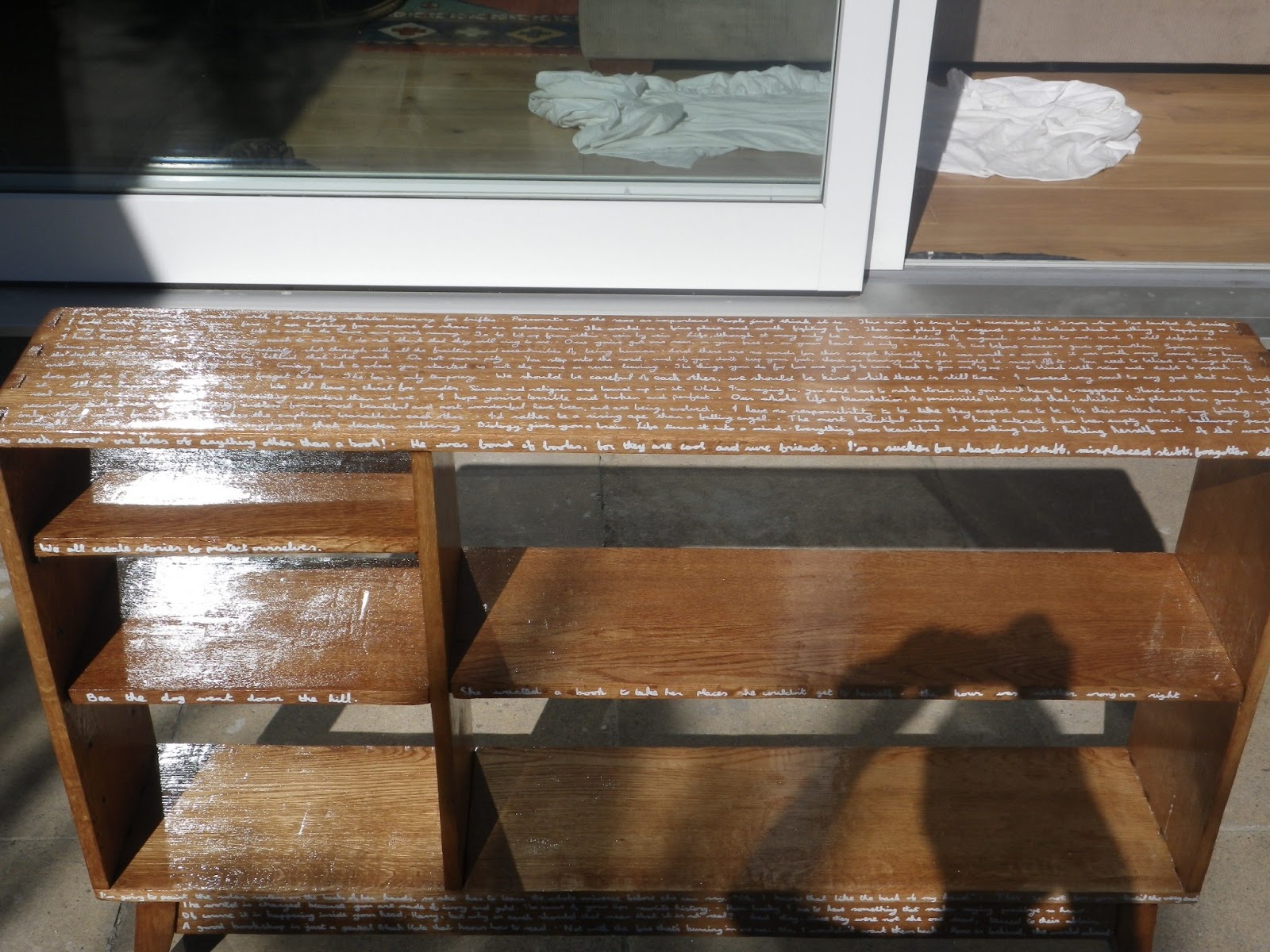
Revamped bookshelf

Over the last few weeks, I have disassembled a bookshelf, then reassembled it to the same bookshelf. There are some extraneous steps in my life.


This bookshelf lived in my brother's room for many years, then in the hallway for a further few. There used to be a door over that panel on the left, but I think it became firewood. My mum was sick of the sight of it, so asked if I wanted to sand it down and revarnish it and take it to my room, because it is years since I have had enough room for books.


I was going to make the legs shorter, but in the end I just pulled out the carpet protectors and sanded down the ends to neaten them up.


I sanded down every side long enough with a borrowed power-sander. I had a headache for most of a day after this, probably from inhaling the powdered dust + varnish + wood combination. Masks are for wimps, I'll avoid giving myself long-term respiratory problems when I'm dead.


I realised the prospect of doing the sides too short for the sander by hand was unpleasant, and that I wouldn't do as good a job as the power-sander, so I dismantled the whole thing. I wasn't sure when I started whether this step would be helpful, but given that it worked out in the end I stand by it.


The dismantling allowed me to sand everything down properly. Hooray!


I glued everything back together with wood glue


and then I varnished it. Given how much darker it made the wood, I'm very glad I went for the clear varnish rather than a stain. Also, while the photos don't show it as well as real life, the varnish really does make the wood look beautiful. It's the first project in a while that I've thought looked beautiful, and that's a pretty fantastic feeling. It's also the first time in a long time I've responded to "That looks well!" with "It does, doesn't it?" instead of, "Oh. Thanks!"


And then I got a paint marker and wrote lines I likes from books and lines from books I like all over the top and sides. (This idea was shamelessly stolen from Cornflower Blue Studios). I have tiny little hand-writing so I had to keep going back for more quotes. My writing isn't actually as round and childish as it looks on this, I was just trying to make spaces in the middle of letters more obvious.


The writing on the lower mini-shelf says "Ben the dog went down the hill." That was the first sentence in my first primary school reader. I'm secretly sentimental, and couldn't find anything else short enough to fit.


I decided to put a layer of varnish over the writing to protect it, and it caused the paint to smear. It was very distressing. I've written over it, but it's not the neatest, which is disappointing.


Here it is in my room! I haven't decided what books go on it yet. It's a weighty decision.


And here is my to-read bookshelf! Some of them are books I saved from being thrown out because I hadn't read them yet, so I don't feel guilt over not having gotten to those yet.

Thursday, April 18, 2013

A literary gripe

This evening I finished reading A Song of Stone, by Iain Banks. I've enjoyed some of his other books, but not this one - I didn't like the writing style, though as it was narrated in the first person it was probably intended to indicate that the narrator is insufferably pretentious, but if that was the case, it did its job too well for my blood. That said, it helped me pinpoint something that hasn't sat right with me in a lot of novels.

My Leaving Cert English teacher said that sex is easy to write badly because it's a repetitive act. I think it's fairest to compare it to eating - they are both carnal acts enjoyed by a majority of people. When people write about eating, they talk about the taste of the food, how it made the people eating feel, the sensations involved in eating. By and large, the descriptions are not of the food being cut, speared on cutlery, chewed until a bolus is formed, then swallowed. When most novelists write sex, however, the focus is on the actions taking place. Different strokes (wahey), and one can argue that sex scenes don't strictly have to be titillating, but I feel if you can write a sex or food scene that is simply boring to people who aren't asexual/anti-food or anhedonic, it's possible that your approach needs tweaking.

Nor do I consider descriptions of appearances/actions full of awkward, cringe-inducing metaphors to be addressing the correct issue, but that could just be me. From A Song of Stone (Chapter 3, page 37 in my version):

Exposed to the night and to my mouth, your breasts were moon-pale, and down-smooth, their aureoles and nipples as dark as bruises, raised, thick and hard like a little finger's topmost joint;....

Call me old-fashioned, but I feel that if your description of breasts causes one person to think about severed fingertips instead of about boobs, that is one person too many.

... Really, the mental image returned to me every time that character was topless.

Monday, August 20, 2012

FO: Willow Tweed gloves

I've been working my way through the Louisa Harding Willow Tweed I bought before Christmas. It's perfect for gloves and mittens - not bulky, but warm, and they look really elegant with lace patterns. I've been plugging patterns from my stitchionary into my own glove pattern and seeing how they turn out - I'm not making these for anything in particular, so it's no loss to rip them out if they don't suit.  I have a run of birthdays in October, so really I should be starting on those, or Christmas presents (this year I will be organised, this year will be the year), but that will mean buying more yarn, so I'm saving it for a big yarn-shopping day.


I made these gloves in a reversible layette stitch...


... which actually look quite different inside-out, so perhaps they are not so reversible, or I didn't follow the pattern correctly. I like the look of the pattern both ways, but for the gloves I prefer the lacier, right-side-out look.


Another pair in grass stitch. The yarn is a lovely soft spring green, which doesn't quite come out in the pictures, and I think it suits this stitch very well.


I was in the mood for cables, but by the time I had finished the thumb I realised that one of them was going to be wrapped around the side of the hand, so I've ripped out to the cuff since I took the photos this evening. After ripping out I decided that this yarn looks too beautiful in lace not to use it for that - cables suit chunky yarn as well, so I can sate myself with a bulkier project next.

-

In an ongoing attempt to clear my room, I have made a pile of all the books that have been sitting on my shelves, unread, for years (distinct from my To Read pile, which throughout my degree has been growing on the set of shelves I use for college notes). When I read them they can either go back on the shelf, or go to a charity shop. For the last few weeks I've been reading fantasy written for an age slightly younger than I was when I received it, because if I gave away a present without reading it I would feel like a terrible ungrateful brat. It's put me in the mood for fantasy though, so I'm going to treat myself to House of Leaves (shelf-pile) and H.P. Lovecraft (To Read pile) once I've worked through them (and the biographies of Hitler and Stalin, which I bought in a fit of history interest and then didn't read because I just didn't want to be that sad about the world). Having the luxury of reading books I don't really want to so I can get to the ones I do is a strange and wonderful one. Maybe I should never go back to academia.

Sunday, June 3, 2012

Science in cinema

for two films, a TV show, and a book. So you can't say I didn't say.

A disproportionate amount of the films and TV I've watched recently have had science as a key plot point. I'm all for creative license - I know if I were to start working in an office very few people would be as fabulous as Joan Holloway - but if a work is trying to address the issues of the day, or raise important questions, I do think they're due some regards for facts.

So, here is what I think of things I have seen recently, and one thing I have read!

-

Contact by Carl Sagan (1985)

I like this book an awful lot. I found the writing style to be extremely elegant - it's almost in the style of a report, not florid for its own sake, and yet still evocative and moving. Maybe that's just because the story is told through someone* who loves science, and hot damn do I love science. It seems as though it should be dry, and yet it's not, which I think is some feat.

One thing I love about this book is the accuracy of the timescale. It starts sometime in the eighties, and ends around the turn or the milennium. It's funny, because the back cover of my copy promises "Aliens are coming to judge us" and the book itself describes in loving or masochistic detail the waiting, and the struggles for funding, and the internal power struggles, and the politics of big discoveries, and some further waiting. Between the style and the content - the book is over three quarters of the way through before aliens make any sort of appearance, and they don't really have that much to do with it - I can see how it wouldn't be for everyone, but I really like the respect Sagan shows for the tedium.

The book is also an ongoing discussion of the relationship between religion and science. Sagan was famously good at courteously debating believers in real life, and in his book he doesn't reduce the religious spokespeople to mulishly short-sighted hillbillies, but allows them intelligent discussion. One of them is the strongest characters in the book. It was refreshing to see that degree of complexity explored, when the debate in pop culture is often reduced to "invisible sky wizard, hurr"/"evil soulless monsters spitting in God's face", depending on who the writer agrees with.

If I'm honest, I didn't like the ending - searching for the imprint of the maker of the universe in primes - but Carl Sagan is flat-out better than I, he can do what he wants.

Also, I will never say no to The Future, as predicted by the eighties.

-

Contact (1997)

Okay, I realise they can't have three quarters of the film be Jodie Foster sitting in a dark room waiting for something to happen. It was never going to compare well to the book for accuracy. It shows the squabbling for funding at the start, at has a "Four Years Later" cut-scene, but after that, it falls into the trap of having everything happen at once. They discover the message, then they discover the image within the message, then they discover the blueprint within that, the latter two within minutes of each other. Everything is discovered by the one group of people, as well. Sagan allows non-characters to make discoveries and collaborate on research, rather than have his characters be the shining geniuses every step of the way.  These are all pedantic points, but they're so commonly ignored in pop depictions of science, and the source material addressed them so maturely that it's a disappointment. As these things go, it's quite a good depiction of science.

The only part of the film that really jarred with me from a "That is not how science works" perspective was the ending. Jodie Foster leaves the building where she was being questioned about her experience in the machine, having conceded that she can't reasonably expect anyone to take her word for it, to be met by cheering crowds howling signs saying that they believe her. On a personal level, anyone would love that level of support, especially after hours of questions from a mean government man. As a scientist, I'm not sure how I would feel if I had no evidence for my findings, and people chose to believe it because it made a good story. I feel it strays from the point of the book. And science. (Also, surely she would have noticed the crowds on her way in to the building.)

-

Prometheus (2012)

Everyone in this film is a terrible scientist, with the exception of the geologist, and I'm only giving him a pass because he doesn't do any geologing.  The stated aim of the voyage was that it was a scientific expedition, and at no point does anyone adhere to anything resembling the scientific method.

The thesis of the two... archaeologists? Maybe? is that as the same images appear around the world, they must represent something real. That it quite a jump, and not a reason to spend trillions of dollars. It's also uncomfortably reminiscent of the argument for theism that all these separate cultures can't have come up with religions and afterlives and creation myths on their own, so there must be something to it.

When it turns out that the space-god-aliens are dead, the male archaeologist sulks and goes drinking and says that the expedition has been for nothing. Then his drink poisoned by morally ambiguous Michael Fassbender robot, so I guess that's a lesson in not giving up the second things don't turn out the way you want them to. Really, I have no idea how he completed a PhD with that attitude.

On a technique-based note, Noomi Rapace and Ford are awfully careless with the two thousand-year-old, immaculately preserved head they find. "Oh look, are those living cells on the outer surface?" Maybe, but it seems more likely that they belong to a detrivorous micro-organism than to the head! And why would they assume the brain has the same structure as a human brain when they start shocking it to see what happens? And why has their DNA apparently not diverged from humans in the interim since our creation? And why did this scene sound like the writes wrote down all the biological-ish terms they knew and tried to work them in?

On a personal note, I hope that one thing that comes out of this kind of sci-fi is that when space travel becomes common, there are safety procedures for dealing with terrifying aliens. Also space-ghosts.

-

Jekyll (2007)

I like Steven Moffat quite a lot when he wrotes short, contained stories. It's just a pity he can't carry an arc in  Doctor Who. (Hee.) This one is about a man, Tom Jackman, who learns he's a descendant of Doctor Jekyll, and begins to lose control of the Hyde alter-ego. He also gets chased by a shadowy organisation who want to use Hyde for research

This story isn't hugely grounded in science, but a theory floated by one character is that Jackman is a clone of Henry Jekyll created by the shadowy organisation, since the latter left no children.  She says that Jackman was never born, but "grown here". NOT HOW CLONING WORKS. First of all, a DNA sample is required, which means tissue that's been dead for more than minutes will be useless. Secondly, since cells can't yet be induced to develop fully - or even very far at all - in a lab, an artificially created zygote still needs a surrogate mother. The only developmental stage of 'test tube babies' that occurs in vitro is fertilisation.

The twist is that there was never a potion, Hyde was brought out by Jekyll's love of his servant, Alice. The second twist is that it is Jackman's wife, Claire, who is the clone of Alice. Claire is horrified by this revelation, insisting "I'm a real person!" I wasn't aware of that as a stereotype, that if you're a clone of someone you somehow don't count. I can't see how being genetically identical to someone affects your personhood - after all, identical twins exist. I can see how she'd react like that if she found out she were a robot that had been programmed to believe it were human, but I think writing in that horror - at the fact of being a clone, not that fact of being created to turn her husband into a weapon - shows a fundamental misunderstanding of cloning, to the point of being irresponsible writing.

-

In conclusion, science is good, and the scientific method is good, and you can't use your films to accuse scientists of playing god if they haven't performed any science, and if you're writing about hot topics you should understand them, not pander to misinformation.

* I cannot remember the term for the narrative style is omniscient, but focuses on the perspective of a single character rather than jumping between them. Writer people, help?

P.S. I had reached the bust of the top I mentioned in the previous post when I realised it was going to be too wide and rip it all out. It was very sad.

Tuesday, August 30, 2011

Dhá leabhair.

Home again!  My bed is the best bed.  Also my brother's girlfriend visited while I was away, and left me


which was a pretty nice surprise.  Apparently she had a favourite one, so it'd be nice to make that as a thank you, but my mum and sister can't remember which one it was.

In other book news, one of the best books I scavenged while away was The Immortal Life of Henrietta Lacks.  It tells the story of the woman behind HeLa cells, her family history and her surviving relatives, how the cells were cultured and how they've been used, some of the debates and court cases that have involved consent and research, and it's just great.  If you're interested in molecular biology or ethics or friendship or people or bodily autonomy I recommend it.

Saturday, April 2, 2011

Birds in their little nest...

My parents were thirty years married last Friday.  I wanted to make them something either practical or small, but I've already made most of the practical things my abilities permit (even for jokey things like "Knit matching hats, ho ho", I've made them both hats with the same pattern so that's kind of gone...) so I went for small.


One of my mother fondest sayings is "Birds in their little nests must all agree to live in peace and harmony."  So I made two little birds in their little nest, with five pearly beads for eggs.  (I'm child number four of five, and thirty years in the pearl anniversary, so Google tells me.)


This one is blurrier, but you can see the eggs!

The teeny birds are a pattern from Knitting Mochimochi, by Anna Hrachovec.  The mammy bird is made from yarn leftover from a shrug I made my mother; unfortunately the only things I've made for my dad have needed bulky wool which would have resulted in a giant blobby bird.  The nest was made by threading the beads through silver wire and then twisting it with round-nosed pliers.  I do like my little nests!

In more family-related news, my brother's girlfriend is visiting from America.  She brought me over this:


The chain started in Ithaca, where they used to live.  I am very happy with it because
a) It combines books and food, two of my favourite things
b) Veggie recipes I've found in books here tend to be either sidenotes or bland bland bland.  I like flavour!

She also tells me that originally their Grumpasauri were facing off against each other, but now they've teamed up on top of the bookshelf.  Cute.

P.S.  The cherry-blossom tree outside my house looks like this these days: