Showing posts with label watch your language. Show all posts

Sunday, June 9, 2013

No, Luke, I AM your [spoilers].

Here be spoilers, but only to things that happened thirty years ago, and vague references to things which contain twists.

I think the internet's reactions to the Red Wedding versus John Harrison is interesting, because it shows the difference in spoiler-etiquette between those who are in the habit of being in a fandom and those who are not.

I don't know at what point it becomes acceptable to stop being careful around spoilers, but it's longer than "twenty minutes after that book is published/episode airs/film premiere screens." Even if someone if watching Star Wars for the first time (if they are older than twelve or so), it should hardly count as a spoiler to mention that Vader is Luke and Leia's father. It's fair game to make a joke about soylent green being people. Everyone knows Norman Bates mother was dead the whole time, as was Bruce Willis. It is safe to mention any of these things in conversation without being a jerk.

My sister, who has read the A Song Of Ice And Fire books already, advised me a week before the Red Wedding to catch up on Game of Thrones in time for that episode, because something important would happen and the internet would spoil it for me if I didn't watch it straight away. I thought this was a bit unfair on the internet - I've been years behind on shows and avoided spoilers easily! - but it aired on Saturday, I watched it on Sunday, and a friend who hadn't seen it yet had it spoiled by Facebook and Twitter by Monday.

I think it's because Game of Thrones is so widely popular. A lot of the fanbase are people who aren't usually heavily invested in a series, don't know the spoiler etiquette, and so reacted loudly and in detail on Facebook. Anyone who has spent any time hanging around forums or fansites and reading fan theories and fics and accidentally discovering what slash is at eleven because the masthead made it seem like it was a synonym for 'spoof' and feeling terrible Catholic Guilt as a result* knows that you tag your damn spoilers. If it's a TV series, you tag them by series at the least, and episode really. I think that's why, even though Star Trek: Into Darkness has been out for a month now, the internet has been pretty decent about not revealing John Harrison's identity. Even though the reboot doesn't have much to do with the original, the kind of people who'd go to see it are largely the kind of people who've obsessed over at least one series in their lives, and so know what bad form spoilers are. I began watching both Doctor Who and Supernatural years after they started airing, and the only things I knew in advance were general plot points (Space! This guy will be a new guy after this series! Bobby! Dean and Castiel don't kiss but the internet thinks they should!), and things I spoiled for myself by opting to disregard spoiler warnings**. Obsessive fanpeople: they are very considerate in specific contexts.

-

In further fanperson sensibilities, I find the semi-meme of referring to "Jawn" in the Sherlock fandom interesting. It's presumably meant to indicate Sherlock's pronunciation of it, but in my head he pronounces it "John", and "Jawn" reads like a drawl, and so more American. If they were trying to show the clipped, British intonation I would go for "Jaun" (as in faun, not maus). "Jawn" is close to how my head pronounces "Jon" which for some reason seems more American-sounding to me than does "John." Regional dialects - they are fun to dissect!

*Based on a true story!
** I spoiled the Red Wedding for myself, I had John Harrison spoiled for me in a post which used his real name a few days after ST:ID came out, which was the more inconsiderate given that most posts at the time were making a point of referring to him only as "John Harrison".

Monday, December 31, 2012

Linguistics, accuracy, utility and common courtesy.

I went to see The Hobbit today, and I was going to write about that, but it would only have been what I liked or didn't from a fanperson perspective. Instead, here are some of my opinions on grammar!

I am a bit of a nerd for grammar. In fifth and sixth year I spent a long time considering studying linguistics. My Leaving Cert Spanish teacher once told me that it was clear from my translations and essays that I had a very good grasp of English grammar, which transferred well in understanding the underlying principles. (Thanks, I speak it like a native!) I taught myself Latin for the Junior Cert because I wanted to understand the roots of words and a more rigid set of grammar rules. I will correct my own grammar in conversation rather than hope people don't notice, because it will irk me to leave it incorrect.

In a complete non-contradiction, there are few things that will make me negatively and immediately judge someone's entire character as hearing or seeing them correct someone else's grammar, in real life or online.

To get the exceptions out of the way: You might be a teacher, they might be learning a language and have asked you for pointers*, they might be learning a first language, they might have asked you to proofread a document. If there are others, I can't think of them at this time.

There's a line by Feynman in What Do You Care What Other People Think? that I can't find by skimming through it. He explains that in school he was a poor speller, and that it frustrated him that his teachers cared so much. If it was clear which word he was trying to use, why did it matter whether there were a few letters missing or rearranged? The lesson here isn't that, if you have a good grasp of grammar or are good at spelling, you are smarter than Richard Feynman. It's that Richard Feynman didn't have time for pedanticism where it wasn't needed, and was an uncommonly intelligent man, and these two facts had nothing to do with each other.

Convention is a very handy thing, but the meaning can usually be guessed from context (there/their, you're/your), and if someone is speaking to you casually, or chatting online, or posting in a forum, the aim is surely to communicate, not write eloquent and elegant prose, or even full words. If you halt a conversation because, and to discuss the fact that, someone has offended your sense of aesthetics, you are a terrible conversationalist. People launch into histrionics like "That hurt my eyes to read" or personal attacks like "It's hard to take you seriously when you can't even run a spell-check [in this online discussion in which many people are posting balderdash as truth because they can't be bothered to check Google]" as though they hold the intellectual high-ground. As I said, regardless of what's technically correct (the best kind of correct), the degree to which someone's spelling error or use of txt spk bothers you is down to your own sense of aesthetics, and is no more high-minded than "Can you believe she thinks that top with that skirt?" Language is for communication, and clothes are for not being naked, and bad language and ugly clothes work just fine to those ends.

It seems particularly snobbish to jump down someone's throat for a mistake in English, which is an absolute mongrel language. (Fun grammar fact! When English was being standardised, the pluralisation of 'child' fell through some crack in the system and became a double plural.)

As I said, I am a sap for eloquence, which usually includes good grammar. By all means, correct your own grammar! Let your eye twitch when someone wants to talk about "there expereince"! But say anything about it (barring the caveats above), and you are being flat-out obnoxious.

* I find it really difficult to correct someone's grammar even when they've asked me to. I worked in a language school last Summer, and when I was chatting with the Spanish kids I found it difficult to fight the impulse to speak Spanish so that we could actually have a conversation, or to correct even the most enthusiastic students, even though they were paying to improve their grammar. It's just so abrasive in every other context!

Saturday, July 28, 2012

Natural flair

There's a photo on the mantle-piece of my family's sitting room of me as a toddler, sitting in a little wooden chair unaided for the first time. The photo is a little blurry, either due to the camera or the rush to document the moment before I fell over, and my fat little face is beaming with delight, probably because of the fuss rather than pride at my sitting abilities. Evidently it was a big deal because previous attempts at sitting me upright had been met with failure.

It is crass to brag, but these days I can sit like a pro on all sorts of things. No-one ever feels the need to record it, or tell me what a good job I'm doing, and it just comes naturally.

-

I'm perpetually confused and frustrated by the idea that you need to have an innate aptitude for certain fields if you are to excel in them. An inborn knack is certainly a boon and timesaver, but to think it's essential flies in the face of the lived experience of every adult who started out as a baby. Babies aren't great at just about anything, especially vocalisation or fine motor control, but most of them turn into attestments to the species' capacity for complex language and tool use.*

This viewpoint is quite prevalent with regards to maths and art in particular. With maths, it's easy to see how a methodical way of thinking is an advantage, but it's not the be-all and end-all. In fifth year I went on a big maths buzz and got consistent As. In my Leaving Cert, when I was more focused and giving roughly equal time to all my subjects, I came out with a C1. I gave maths as much time as my other subjects, but due to being average at it, compared to quite good at the others, I didn't score as well. But when I put more time and effort in, I did! BIZARRO!

It's not at all hard to see the appeal of the fallacy. There's nothing like trying something and discovering that you're good at it. When I was in Junior Infants and we were given a page of reading to do from our reader, I dicovered I knew how to read. I had always made my very patient mother read stacks of books to me, and apparently I had picked it up without realising it. I was so excited that I made my mum sit with me while I read the whole book.** By the time I was in Senior Infants, when it was my turn to go up to the teacher's desk, I would bring my own book because I had surpassed the levels of the readers.  Seventeen years and many books, textbooks, articles and papers later, that moment of understanding the symbols "Ben the dog rolls down the hill" still stands out as a high point in my life. Man. Reading.

But everyone I went to school with is literate! I might still be speedier at it or have a wider vocabulary than some of my classmates, but everyone got to a level they needed by working at it.

What bothers me, because I'm painfully literal***, is that "I'm not good at X" can be a perfectly true statement, but it comes with an implicit "AND THEREFORE I NEVER WILL BE," which is not a logical conclusion! It is true for me to say "I am not good at dancing," because I am ungraceful, and have made no concerted efforts not to be, so my version of dancing involves wooden flailing and shuffling and accidentally bumping into people. For the time being, I don't mind that (though bumping into people is not ideal), so I will continue to not be good at dancing, though I could correct it by going to classes or something. It is possible I will never be good at it, but that will be through a conscious lack of effort on my own part.

There's a big difference between "I'm not good at it now, and it's not important enough to me to work on becoming good at it" and "I wasn't magically good at it the first time I tried, so I'm doomed to mediocrity." There's nothing wrong with mediocrity, but it's not inevitable!

This wouldn't bother me as much as it does but for how it affects children. I think children should be praised for efforts they make, rather than for being good at something. It is easy to fuss when a child produces a picture better than their age, but if you don't fuss when they produce something average, you might kill their enthusiasm and stop them from having a chance at being good at it, or never being good but taking joy in it anyway.

That just seems so sad.

*It is really interesting how young children learn grammar, especially irregular verbs! For example, they will initially use "ran", then as they work out the general rules of grammar will use "runned", then they will learn that that verb is irregular because English is a nonsense language, and go back to "run".

Also, my friend's three-year-old knew the noun 'hyperbole' but no form of the verb 'exaggerate', and wanted to challenge some ridiculous story his father was telling, so accused him of hyperbolating. What an amazing three-year-old.

** I was surprised to learn that I still had to go back to school the next day. I knew how to read! What else was there?

*** Which makes me quite good at languages, because I'll have an appreciation of how the grammar works, rather than relying on "This phrase is the rough equivalent of that phrase", but means I sometimes fail to realise exactly what conversation I'm having with English speakers. I will leave and realise I answered someone's question inaccurately because the answer to the question with the words the used was "No" but the answer to what those words are commonly understood to mean by native or fluent English speakers is "Yes." It is kind of a problem.

Monday, November 28, 2011

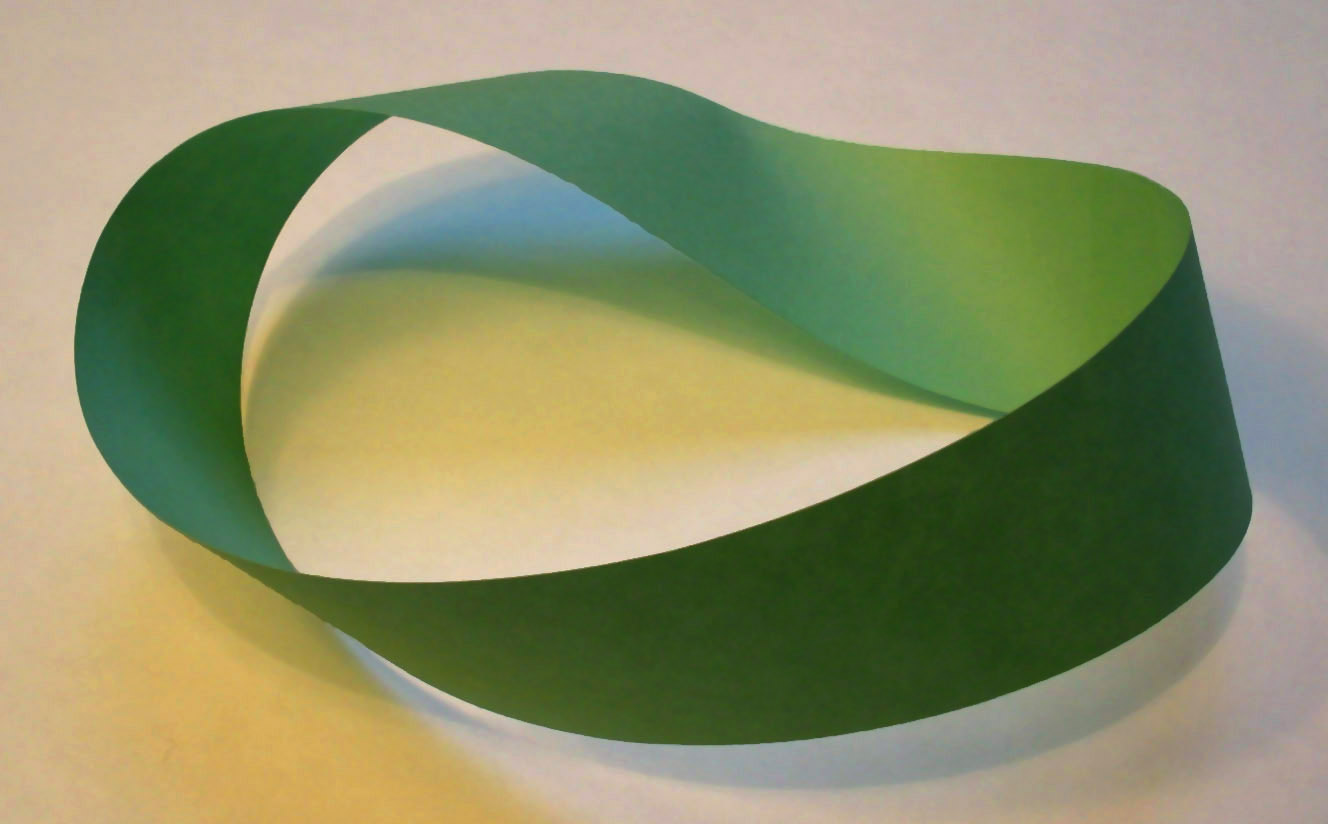
The mobius scarf.

I am going to use the phrase "Mobius scarf" about fifty times in this post so that other people in my position might come across it in their Googling and not make the same mistake I did.

A mobius strip, for those who aren't maths geeks, is "a surface with only one side and only one boundary component."


Pretty cool!  So imagine how excited I was when I discovered I could combine my enthusiuasm for maths with an enthusiasm for knitting in the Mobius scarf!  I made one of these Mobius scarves for a friend, and I like how it turned out, but as I found the start of the pattern a little difficult to work, I had to use another pattern for advice.

As mentioned in an earlier post, my brother's girlfriend is coming over for Christmas, and as she's a scientist I thought she would appreciate a Mobius scarf!  Alas, I couldn't find the tutorial that had helped me out the first time.  I did, however, come across a few sources telling me that to make a Mobius scarf, I should twist to join in the round.  How handy!  Alas again!  The finished product wasn't a Mobius scarf, but had a complete twist in it.  I must have over-twisted it.  No matter, start again.  This time it would be a snuggly feat of maths!

Nope.

I read this (lovely) tutorial yesterday, and something about it seemed strange to me.

"Depending on what you like, you can leave some twists to create a mobius-like effect, or get all the twists out for a more traditional scarf."

"MOBIUS STRIPS DO NOT WORK THAT WAY."


Thank you, Morbo.

So it turns out that "Mobius scarf", in the knitting community, refers to any twisted circle scarf rather than a cosy mathematical quirk.  Good to know!  For my own part, I'm surly and have changed my mind about how much she'd like it (Do microbiologists instantly like maths?  Who knows), so it's going to be a plain ol' circle scarf instead.

... 

Mobius scarf.

Friday, October 14, 2011

Words are tricky, except when they're not.


The internet's crush on Stephen Fry is perfectly understandable.  No-one, hive-minds included, shouldn't have a crush on Stephen Fry.  That said, I rather wish he hadn't said this.

I understand not caring that someone is 'offended' by gay couples existing right there in public, or by schools not being segregated, or by God being removed from the constitution (not that that's a concern in Ireland, ever.  And yet some people are concerned about the lack of Jesus in daily life!).  Like this woman.  This woman is a small person, and if I met her and she made me a cake and let me play with a puppy I wouldn't like her.  The problem is that in these cases, the word is being misappropriated, and thanks to this "I'm offended" has come to mean "I'm whining because the world isn't to my sensibilities, wah."

The word "offended" needs to exist, though, or there needs to be a word to replace it.  I know words change in meaning, but "I'm offended" is a nice, blame-shifting way of calling people out on thoughtless or plain abusive language or behaviour - an attack on their personhood, an offensive act in the "opposite of defence" sense of the word.  Needlessly thoughtful, actually, no-one says "I'm punched" after you give them a bloody nose.

The most bizarro thing is that even with the thoughtful "I" and shift in responsibility and use of a watered-down term, people go on the defensive if you suggest they've caused - performed - offense.  "I didn't mean actually retarded/I'm not racist/My gay friend laughed."  Good for you, knowing or blithely assuming that you're not a bigot.  Not everyone you meet knows that, and it's not their responsibility to give you the benefit of the doubt - you need to show it.  Not using dehumanising terms, or purely descriptive words as insults, is a bang-up start.  Otherwise, however cluelessly or unintentionally, you're attacking them.  Going on the offensive, one might say.  And then, through your actions and yours alone, they're attacked.  Offended, to use a slightly old sense of the word.


-

My feminism will be intersectional or it will be bullshit.  I read the title of this post and thought "Wow I want to tattoo that on my face put that on some form of clothing," then I read the post itself, and felt sad and squirmy.

I'm not very fussy about labels.  If I find something that describes something I already feel like, I'll adopt that, but only because it sometimes saves on wordy descriptions.  I love learning, guess I'm a nerd.  I have girl parts, guess I'm a girl.  I like making things, guess I'm a craftster.  I believe people of all gender and sexual identities are equal, guess I'm a feminist.

The feminism one has always been a little inconvenient because it's a subset of what I believe about equality.  I also believe people of all skin colours, all physical and mental capabilities, all classes are equal.  Everyone is people, all the time!  These things aren't strictly covered by the term "feminist".  But my first feminist blog was Fugitivus)which discusses feminism, race and class - perhaps more extreme than I am now, but I have a fondness for the blog and author, though sadly it seems to have fallen out of use) which led me to my first anti-racism blog ,Stuff White People Do (mainly race-based but has some elements of feminism, as WoC get it from both directions - again, no longer updated but remembered with fondness), where I came across Womanist Musings (race, gender and sexual identity, class, religion, most aspects of social justice, really).  I don't know if I'm bad at logic and assumed people who used the same label as me felt the same as me, but or if the route I took to this section of the internet led me to believe so, but I always assumed that 'feminist' really meant 'social justice-ist, including feminist'.  You don't have to act on all the issues ever, but how can you care about one and not at least see the rest to be wrong.  Then stuff like this happens:


and some people actually defend it and try to call it a feminist act.  So maybe I need a new word.

-

My little brother, who has just started studying in the same college as me, texted me today to ask if he could come heat up some food in my microwave.  When he got here, he had milk, tea, biscuits (two packets as he didn't know what kind I like), and two packets of pasta.  It made me feel all fuzzy inside.  Nice things happen too!

Thursday, March 10, 2011

More than the sum of the parts.

I was raised as a Catholic.  It didn't work out.  The parts I agree with are common sense about being a half-decent person, and the parts I don't I really don't.  One can't easily avoid Catholicism in Ireland though.  Today, for example, is Ash Wednesday.  And one minor thing I take issue with is the instruction to
Remember that you are dust, and unto dust you shall return.
I believe this is meant as an instruction in humility - don't go thinking you're so great, you will wither and die and vanish.  This is certainly true regardless of whether you're religious or not.  But what does that have to do with anything?  The fine details don't matter - meat and chemicals and a calcium-based frame are a little more complicated than 'dust', but it's still just stuff, so no big deal.

Whether I care about this or not depends really on whether "You" addresses the individual or all members of the race.  I will live for about sixty more years, then I will die and in a hundred years few people will know my name.  Less, if I don't have children.  If it's the race, though, that's just silly.  These bundles of stuff can think and feel and know.  They can fall in love and burn with hatred and get their hearts broken.  They can create purpose and meaning and gods.  They can care and they can pretend it matters and they can try and try and try.  And I don't understand how that is cheapened by the fact that we're stuff.  I really and truly don't.   I think that's quite an achievement for dust or chemicals or whatever you attribute life to.  I mightn't be much as an individual, but as a phenomenon, I'm pretty fantastic.

Darwin put it much more aptly and more achingly beautifully than I could:

There is a grandeur in this view of life, with its several powers, having originally been breathed into a few forms or into one; and that, whilst this planet has gone on cycling according to the fixed law of gravity, endless forms most beautiful and most wonderful have been, and are being, evolved.

Physics happens and geochemical processes happen and life happens.  Just how it goes.  Being everyday doesn't make any of them any less beautiful. 

Wednesday, January 5, 2011

Posting someone else's thoughts to seem insightful

Sometimes there is no other side - a very good post from a very good blog.

I won't elaborate because the post makes the point very well, and belabouring it would be me talking for the sake of hearing my own voice. A slightly related point, though, is that I really don't like the idea of promoting tolerance. The fact that an individual has to struggle in daily life for people to put up with them is a tragic affair, and law- and policy-makers shouldn't have "barely putting up with someone" as an end goal. You can't force acceptance on people, but in, say, a workplace, if there's a policy in place that says you have to, then the onus is on bigoted people to hide their unpleasant selves, rather than on the target to make themselves bearable for not being The Norm.